Posts

Biofiction

Image
Having discussed some issues around the presentation of self in previous posts through particular influences and examples, this post is going to be a little more abstract. I'm going to consider some of the claims made by Max Saunders in his book, Self-Impression: Life-writing, Autobiografiction and the Forms of Modern Writing (2010). This lengthy study examines the emergence of certain kinds of Modernist writing in the twentieth century out of late nineteenth-century biographical and autobiographical texts. Saunders' book is very handy because of the deft way in which it manages some of the terminology around these topics, considering labels such as biography, autobiography, life-writing and autobiografiction (I'll return to the latter in a bit). One starting point for Saunders is Philippe Lejeune's concept of 'formal autobiography' or 'contractual autobiography', 'in which real author, narrator, and the name on the title‐page all coincide, and seek ...

Waxing lyrical: Moore and Schopenhauer

Image
Caricature of Huysmans In my previous post on Moore and Huysmans I suggested that A rebours (1884)   and Confessions of a Young Man (1887) share a sense of equivocation or ambivalence that might be, in some respects, more truly Decadent than any reference to vice or excess. Another shared connection here is their relation to autobiography. Huysmans' creation, Des Esseintes was frequently taken to be modelled upon himself by critics. And  Confessions of a Young Man presents itself as an autobiography - from the second English edition of 1889, the narrator even shared the same name as the author. In both cases, however, autobiographical identifications are important, but complex and hard to sustain at certain points.*  So, in this post and the next, I'll explore some points around Confessions and its vexed and complex status as autobiography. My starting point is passage from early in chapter 1: I came into the world apparently with a nature like a smooth sheet of wax,...

Huysmans

Image
In the two previous posts, I discussed George Moore's relationship with Émile Zola, suggesting that Confessions of a Young Man reflected a change from admiration and emulation towards a more qualified, even distanced attitude by Moore towards the French novelist. In this post, I'm going to look at the links between Moore and another contemporary French writer, J-K Huysmans. For there are important parallels to be drawn here.  Huysmans is now best known for A rebours (1884), which relates the proclivities of a corrupt and ailing aristocrat, Jean Floressas des Esseintes. Forced into early retirement from Parisian social life by ill health, Des Esseintes retires to his Fontainbleau, where he puts his considerable resources to use in order to indulge his every whim and taste. This ranges from his cultivation of an extreme bibliophile (he commissions bound copies of Baudelaire's work for every day of the week), to sexual excesses (he pursues a complicated relationship with a v...

More Impressions of Zola

Image
This post is going to be a bit shorter and more patchy.* More precisely, it's about a current gap in my research. My previous post provided a bit of general information about Émile Zola and how important he was to George Moore. I suggested that Moore set himself up as an authority on Zola in London in the early 1880s, by writing critical articles about him, translating Zola's work and writing about him in Confessions of a Young Man . As an earlier post pointed out, however, Moore's attitude and disposition towards Zola changed considerably - where his early articles express sympathy and enthusiasm for the French writer, his later was response was more qualified even critical. I'm hoping to capture some of this in the appendices to the critical edition of Confessions that I'm working on, by reproducing some excerpts from Moore's journalism. But this is where I have run into problems, exacerbated by the COVID19 pandemic and crisis. Moore wrote an article for Eng...

Hammering Zola

Image
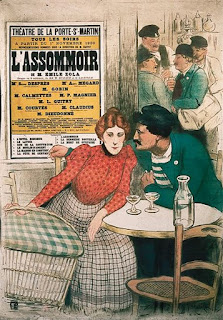
In my previous post I described how George Moore ruined his literary relationship with the French writer Émile Zola through some creatively tactless writing in Confessions of a Young Man. In the next couple of posts, I'm going to explore Moore's relationship with Zola in a bit more detail. So - first off - a bit of background. Zola's reception in the UK was very mixed during the nineteenth century. Known for a frank and explicit form of realism known as Naturalism, he first became famous in France during 1877 for his novel L'Assommoir which describes the lives of a working class family, Gervaise Macquart and her husband, Coupeau in one of the poorer districts of Paris. Although Coupeau rescues Gervaise from an abusive previous relationship, he turns to drink after an accident at work and they both descend into alcoholism and poverty. The title of the book, derives from a verb meaning 'to stun': it's a familiar name for small drinking establishments where wor...

The Nouvelle Athènes

Image
Edgar Degas, 'L'Absinthe' (1875) [Supposedly set in the  Nouvelle Athènes] When the narrator's career as a painter does not work out (due to a lack of talent), he decides to become a writer instead. Accordingly Confessions of a Young Man  transforms from an account of the visual arts into a depiction of the French literary scene. The setting shifts from art school to the famous cafe culture of Paris. Chapter seven is set in the Nouvelle Athènes - a bar just off the Place Pigalle. This part of Paris became infamous in the twentieth century as a red light district, but the area did not have quite the same reputation during the period Moore describes. (The Café de la Nouvelle Athènes was replaced by a strip bar only later.) In the 1870s, Pigalle was more closely associated with the Bohemian artist types who lived in nearby Montmartre. In chapter seven, Moore relates how the café was frequented by writers such as Villiers de l'Isle Adam and painters, such as Edgar Degas...

The Académie Julian

Image
Rudolph Julian I mentioned in my previous post that the narrator of Confessions of a Young Man moves from studying at the École des Beaux Arts to working in a smaller school based in the passage des Panoramas off the Boulevard Montmartre in the 2e arrondissement of Paris. The Académie Julian was founded in 1868 by Pierre Louis Rodolphe Julian (1839-1907), who had moved to Paris from the South of France. Moore was fascinated by Julian* and also wrote about him in an article entitled 'Meissonier and the Salon' for the Fortnightly Review in July 1890: M. Julian was once a shepherd in the south of France. In his native village he established a reputation for extraordinary strength and artistic capacity. He had thrown every young man within twenty miles in the wrestling contests, and he had astonished every one by the skill he showed in drawing. For a time his fate hung in the balance. A great wrestler or a great painter, which was he to be? Moore seems to have been greatly impres...